

Industry: Energy / Hydraulic Fracturing Services

Timeline: 3 months

Asset-Level Telemetry for Industrial Pump Operations

Team: Tempered AI, in partnership with Computomic

4-1-edit
4-2 edit

Executive Summary

BeUSA Energy operates hydraulic fracturing fleets that generate a constant stream of sensor data from mobile pump trailers. The data was being captured in Canary Historian, but it couldn't answer the question that mattered most for maintenance and operations teams: what happened to this specific trailer across its entire operating life? Tempered AI built a production-ready Databricks pipeline that solved the asset identity problem and made high-volume field telemetry analytically useful for the first time.

About the Client

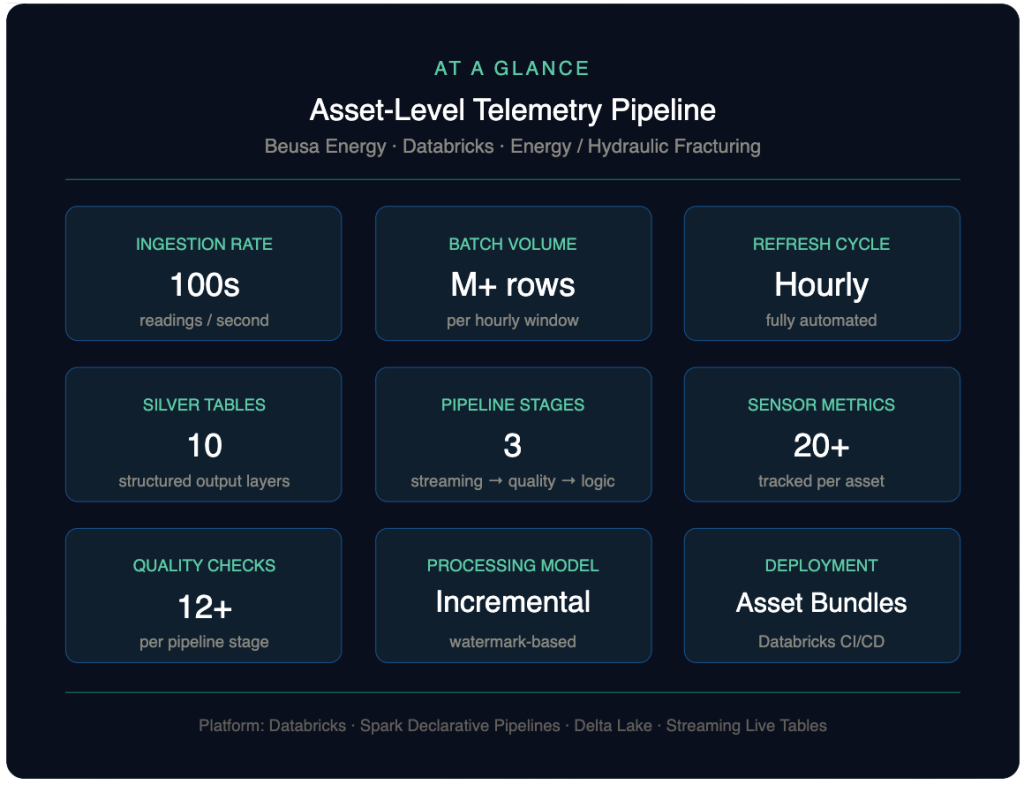
BeUSA Energy runs hydraulic fracturing operations that depend on large fleets of mobile pump trailers. Each trailer continuously produces telemetry, pressure, vibration, flow, pump strokes, and other operating signals, at hundreds of readings per second. At that scale, the system generates millions of rows per hourly window, making data quality and pipeline design critical to any downstream analysis.

The Challenge

Telemetry indexed by position, not by asset

The underlying data source, Canary Historian, tracked readings by line position at the wellsite, not by the physical trailer. That meant the system could show what happened in a given position, but not reconstruct the full history of a specific piece of equipment.

Assets that move, histories that fragment

Pump trailers are regularly removed for maintenance, reassigned to different lines, or redeployed to other fleets. Without asset-level mapping, the operating life of a single trailer was scattered across multiple positions and time periods, with no way to connect the dots.

Volume that ruled out simple approaches

The system produces hundreds of sensor readings per second. Any solution based on full reprocessing on each run was not viable. The pipeline had to handle high-volume, continuous telemetry incrementally, processing only new data while maintaining correctness across the full history.

The Solution

Before designing the pipeline, the team spent time understanding how BeUSA's field operations worked and how trailers were assigned, moved, and tracked. That discovery shaped the core design decision of the project.
The solution was built on Databricks and performs four functions
Ingest :
Normalize :
Resolve asset identity:
Join telemetry to assets:

Technical Highlights

The pipeline runs on Databricks using incremental processing, only new data is processed on each run, which keeps the system efficient at sustained industrial scale. More complex assignment logic was isolated to a smaller transformation where full recomputation was acceptable. This separation balanced correctness, scalability, and operational cost.
The solution also included structured data quality controls. Invalid or suspicious rows were routed to a quarantine layer rather than being silently dropped, giving the team full visibility into data issues while keeping clean data flowing downstream.
Deployment was handled through Databricks Asset Bundles with support for controlled promotion across environments.

The Result

Pump trailer history is now traceable across all line and fleet changes
Pressure, vibration, flow, and runtime can be analyzed by physical asset for the first time
Millions of rows processed per hourly window with a fully incremental, watermark-based pipeline
Data quality issues surface through transparent quarantine controls, nothing is silently lost
Maintenance and reliability teams have the historical context they need to act with confidence
Scalable foundation in place for future predictive maintenance and operational analytics

Why It Works

The core problem wasn't moving telemetry into a lakehouse, it was making that telemetry analytically useful. The team focused on the asset identity problem first, because without solving that, everything downstream would still be fragmented. By designing around how equipment actually moves in the field, the pipeline produces data that reflects operational reality, not just what the source system captured.
Interested in Self-Service Analytics for Your Organization?
Whether you're in energy sector or another highly regulated industry, we can implement analytics platforms that balance accessibility with governance.
4-1-edit (3)
4-1-edit (2)