


Industry: Commercial Manufacturing
Services: AI and Machine Learning
Timeline: 6 Weeks
AI-Powered Sales Enablement for Armstrong World Industries
Team:

May 15, 2026

Executive Summary
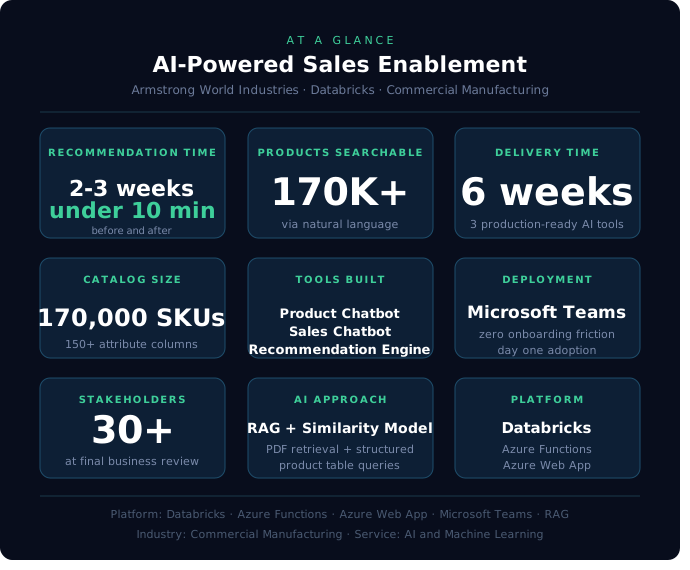
Armstrong World Industries manages a catalog of over 170,000 commercial tile products serving hospitals, schools, and large commercial buildings. Their sales and product data was valuable but practically unusable: spec PDFs no one could search, fragmented regional sales data, and a recommendation process that took sales reps two to three weeks per client. Tempered AI built three production-ready AI tools on Databricks in six weeks, a product knowledge chatbot, a sales intelligence chatbot, and a recommendation engine, turning a weeks-long manual process into one that takes under ten minutes.
About the Client
Armstrong World Industries is a century-old U.S. commercial tile manufacturer serving specialized environments like hospitals, schools, and large commercial buildings. Each project requires a precise combination of tile materials, finishes, dimensions, and performance ratings including humidity resistance, acoustic ratings, and sanitary compliance.
Their product catalog had grown to over 170,000 SKUs, pulled from multiple internal pipelines and partner systems over the years. The result was a wide, complex dataset with over 150 attribute columns per product and a lot of inconsistency baked in.
The Challenge
Armstrong was sitting on a goldmine of product and sales data but had no practical way to use it. Three problems stood out:
A slow recommendation process
When a sales rep met with a new client, they would go back to the office and spend two to three weeks manually researching which tiles and grid systems would be the right fit. Then they'd return with a handful of suggestions. It worked, but it was slow and hard to scale.
The data itself added complexity. A table with 170,000 rows and 150+ columns, heavy null values across many fields, and column names that were entirely internal and undocumented made the early stages of the project demanding.
The Solution
Before writing a single line of code, the team spent significant time with the client's internal data lead, a person who had been with the company for over 20 years and understood the dataset inside and out. That discovery process shaped everything that followed. The team ultimately built three distinct products, all running on Databricks.
Product 1: Product Knowledge Chatbot
A conversational AI assistant that lets users ask plain-language questions about any product in the catalog. It pulls from cleaned and structured product tables and includes a RAG (Retrieval-Augmented Generation) layer that indexed the technical PDFs so their content became searchable for the first time. A user can type "What are the acoustic specs for this tile?" and get a clear answer in seconds.
Product 2: Sales Intelligence Chatbot
A chat interface that gives sales reps access to regional sales data through natural language. Access is filtered by role and territory automatically, so someone in the northeast can query their region's data without seeing anything they should not. Questions like "How did Product X perform in Q1 last year?" can now be answered on the spot.
Product 3: Product Recommendation Engine
The flagship product and the most technically complex piece. A sales rep describes a client's situation and the system figures out what that means: climate, lighting, safety requirements, acoustic needs. It then pulls from the spec PDFs, queries the structured product tables, and runs everything through a similarity model built across the full 170,000-product catalog to surface the top 10 compatible tile and grid combinations. What previously took two to three weeks of manual research now comes back in five to ten minutes.
Technical Highlights
The stack was built on Databricks for all AI and data work, with Azure Functions and an Azure Web App handling the integration layer.
The data itself added complexity from the start. A table with 170,000 rows and 150+ columns, heavy null values across many fields, and column names that were entirely internal and undocumented required significant discovery work before any building could happen. That is why the team spent the first phase working closely with Armstrong's internal data lead, a person who had been with the company for over 20 years, before writing a single line of code.
The most consequential delivery decision was around where the tools would live. Rather than building a separate application that users would need to learn, the team integrated all three tools directly into Microsoft Teams, which Armstrong's team already used daily. Authentication was handled through existing Microsoft accounts, with role-based access logic running in the background. Users just opened Teams and started asking questions, with no onboarding friction and no new passwords.
The recommendation engine was the most technically complex piece. It combined RAG retrieval from spec PDFs, structured queries against the product tables, and a similarity model running across the full 170,000-product catalog to surface the top 10 compatible tile and grid combinations for any given client situation.
The Result
Sales recommendation time reduced from two to three weeks down to under ten minutes
Over 170,000 products searchable through natural language for the first time
Three production-ready AI tools delivered in roughly six weeks
Full adoption from day one since everything lived inside Microsoft Teams, a tool the team already used
Automated security controls with no added complexity for end users
Knowledge transfer sessions and a business review presented to 30+ stakeholders at close
Why It Works
The team came in with a point of view. Rather than asking the client what they wanted and building exactly that, they listened, did the research, and came back with recommendations. When it became clear mid-project that a standalone web app wasn't the right fit, they shifted to the Teams integration without losing momentum.
Regular demos throughout the build kept feedback flowing and meant there were no surprises at the end. And leaning on the client's internal data expert early on made everything downstream faster and more accurate.
Ready to put your product and sales data to work?
Whether you have a complex product catalog, fragmented sales data, or a slow manual process, we can build AI tools that make your team faster from day one.

