

Industry: Healthcare
Service: Databricks Genie Implementation
Timeline: 8 weeks
Natural Language Analytics for a Top-10 U.S. Health System
Team: Tempered AI, in partnership with Computomic

March 24, 2026

Executive Summary
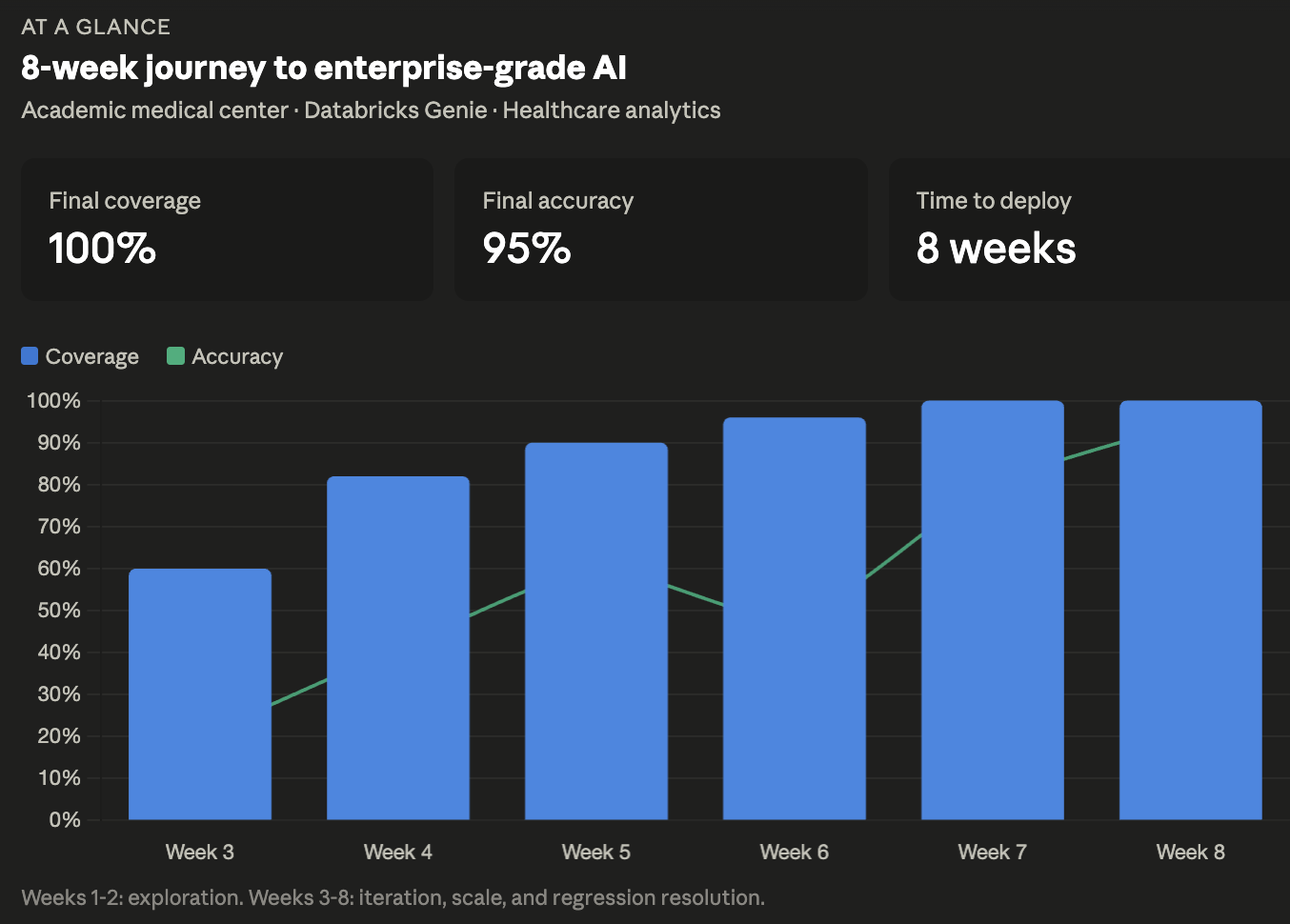
A leading academic medical center is one of the largest health systems in the United States, managing complex financial and operational data across multiple campuses and service lines. Leadership needed instant, trusted answers from that data without depending on analysts for every question. Tempered AI delivered a production-ready Databricks Genie Space in 8 weeks, giving finance and operations executives a natural language interface to query their data directly, with 95% accuracy and full HIPAA-compliant governance built in.
About the Client
This client is a world-class academic medical center and health system operating across multiple campuses, managing a broad range of inpatient and outpatient services, from surgical care to emergency medicine. Like most large health systems, they generate enormous volumes of operational and financial data across diverse business units, and leadership depends on that data to make decisions about performance, resources, and strategy.
The Challenge
The primary bottleneck for business leadership at this health system was not the availability of data, but the overreliance on technical teams to interpret it. Even straightforward questions like "What was the contribution margin by service line last quarter?" required analyst involvement, creating delays that slowed decision-making across the organization.
Healthcare data is complex and regulated
Financial and operational reporting in a health system is not straightforward. Inpatient and outpatient care follow different metrics, units, and reporting standards. Contribution margin, case mix index, OR hours, and length of stay all have precise definitions that vary by context. Any analytics tool had to reflect those rules exactly, not approximate them.
What We Built
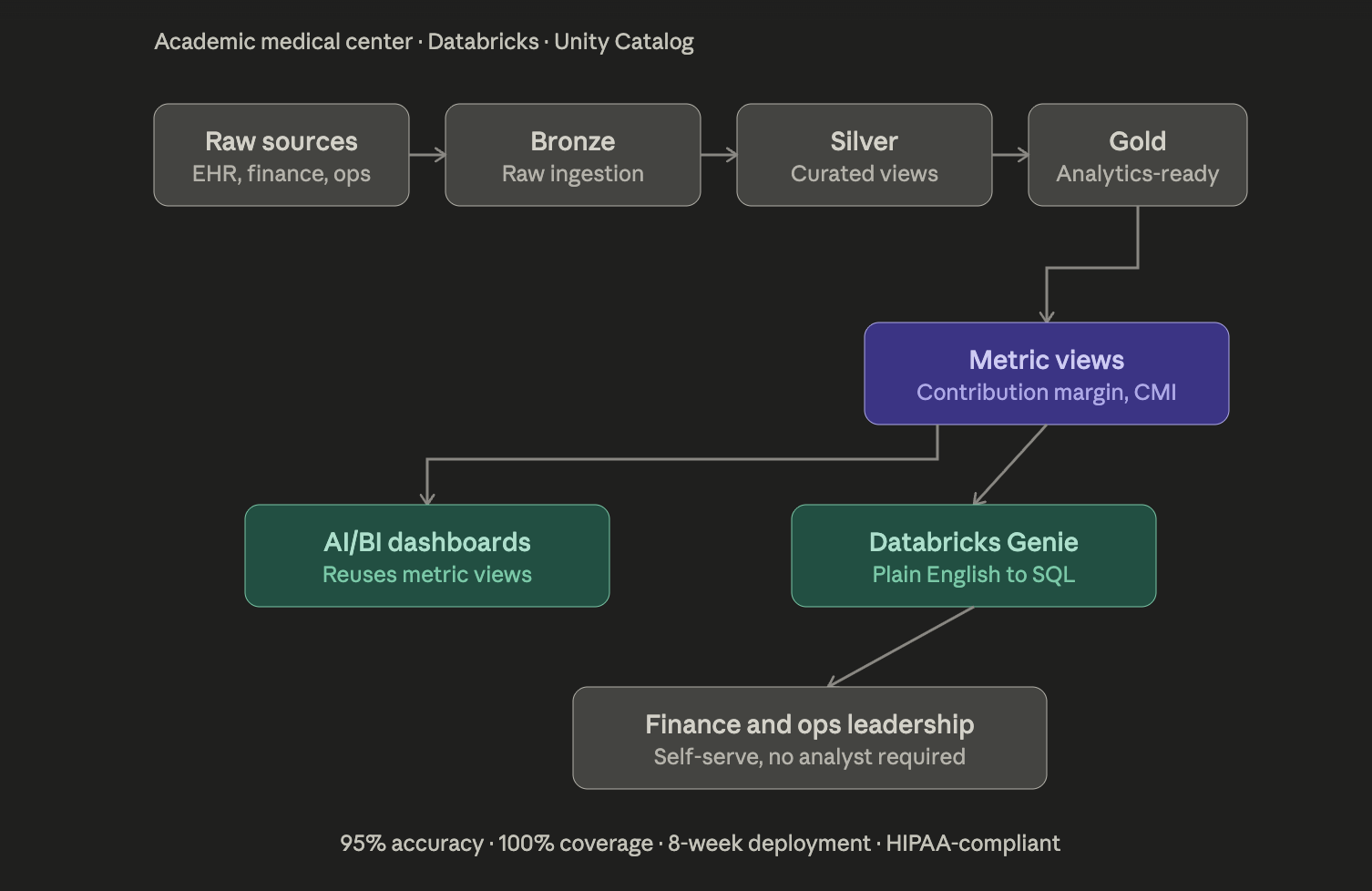
A production-ready Databricks Genie Space that lets finance and operations leaders ask questions in plain English and get accurate, governed answers in seconds. A user can ask "Show me Contribution Margin Ratio by service line for inpatient cases in FY25, broken down by campus" and Genie translates that into SQL, runs it, and returns a table or visualization, without involving an analyst.
The 8-week project ran in two phases. The first focused on discovery and foundation building, including use case definition, data architecture design, and semantic layer construction. The second phase built and productionalized the Genie Space through iterative validation, structured user acceptance testing, and deployment to production.
Key Features:
Natural Language Querying
Executives type questions in plain English and get results in seconds. Genie translates the question into optimized SQL and returns tables or visualizations without requiring any technical knowledge from the user.
Precisely Defined Semantic Layer
Metric definitions for contribution margin, case mix index, OR hours, length of stay, payor group, service line, and more are encoded directly into the system, with plain English descriptions and synonyms. The model does not guess how metrics are defined, it knows.
Inpatient and Outpatient Coverage
The health system tracks inpatient and outpatient care differently. The system handles both in a single interface with the correct logic for each, including surgical cases, ED admissions, observation stays, and ambulatory surgery encounters.
Guardrails and Behavioral Instructions
Genie is configured to handle ambiguous questions, apply time periods correctly, and communicate clearly when it cannot answer rather than return an uncertain result.
HIPAA-Compliant Security
Row-level and column-level security ensure sensitive patient data stays protected. Users access only what their role permits, with all access logged for compliance auditing.
Query History and Audit Trail
All queries are logged with user attribution, timestamps, and results, meeting healthcare compliance requirements while enabling teams to learn from each other's analytical approaches.
The Result
Production-ready Genie Space live in 8 weeks
95% accuracy across question types, validated through structured user acceptance testing
Finance and operations leaders get answers to complex questions in seconds, without analyst involvement
Full coverage across inpatient and outpatient operations including volume trends, financial performance, OR metrics, length of stay, and case mix
HIPAA-compliant with row-level and column-level security and full audit trail
Internal team fully equipped to maintain and evolve the system independently
Why It Works
Delivering a conversational AI product that performs reliably in healthcare and finance requires more than a good AI model. It requires a clean, well-governed data foundation, a precisely defined semantic layer, and careful configuration of how the model behaves. That is where the most critical work took place. The Genie interface is what users see, but the accuracy they experience is a result of the engineering beneath it. Close collaboration with the client's finance and operations teams was what made production-grade accuracy possible."
Ready to give your leadership team direct access to your data?
We can implement a governed, natural language analytics platform calibrated to your business metrics and your environment.

